Nursery gear: what you can safely skip
Which nursery items are safe to skip, per AAP guidance — and why the nesting urge to overbuy shows up in the first place, from identity shifts to workplace prep.
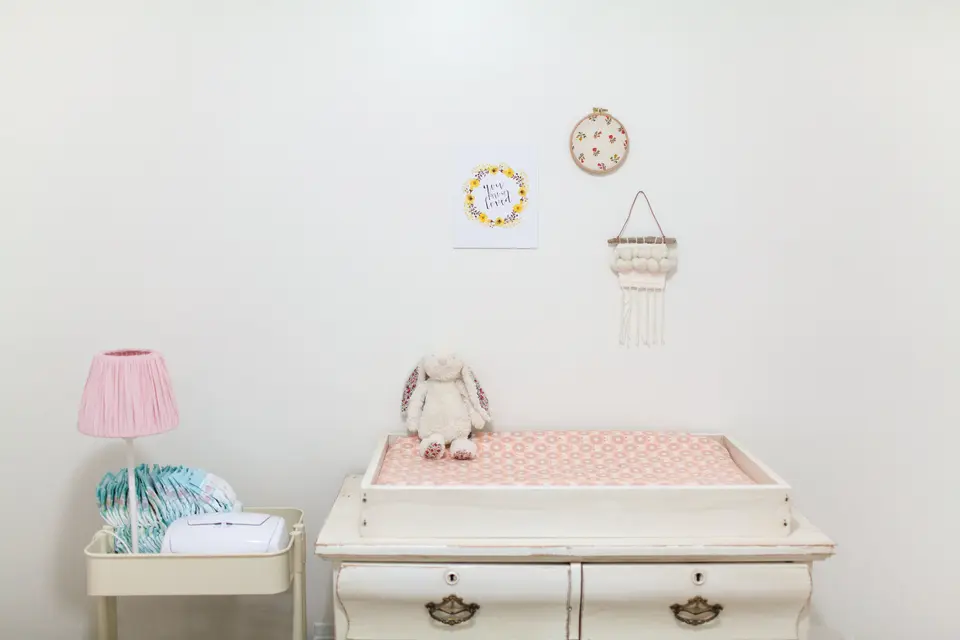
In short
You can skip crib bumpers and infant sleep positioners entirely. Those are wedges or mats that hold your baby in one sleep position. Pediatric guidance says both can be unsafe, not just unnecessary. The urge to buy more nursery gear often comes from the bigger identity shift of becoming a parent (matrescence). It's not about what your baby actually needs in the first weeks. It can help more to sort out your workplace rights than to buy another item for the nursery. Think pumping breaks and pregnancy accommodations.
Sourced from AAP (HealthyChildren.org), EEOC, PMC (peer-reviewed research), PMC (peer-reviewed meta-analysis) · Updated August 15, 2026
Somewhere between the second trimester and your due date, most expecting parents hit a moment where the nursery — or the registry, or the browser tabs — feels like a to-do list that's never quite finished. Nesting is a real, often welcome instinct. It's a way of turning nervous energy into something productive. But the gear industry built around pregnancy is very good at turning that instinct into purchases. Not every item on a typical registry deserves a spot in your home. Some are simply unnecessary. A couple are things pediatric guidance actively warns against.
This isn't a case for going without. It's a case for being selective, and for knowing that a few widely marketed 'must-haves' carry real safety guidance against them — not just a shrug. Knowing which items to skip, and why the urge to keep buying shows up in the first place, can turn an overwhelming registry into a much shorter, calmer one.
Why do registries make you feel like you need everything?
Nesting gets talked about like a quirky pregnancy symptom. But it's also a predictable moment when people make a lot of purchasing decisions fast — often driven by 'everyone else has this' registry checklists, not real need. That's not a criticism if you've bought more than you used. It's just how this shopping category is built. A long list of items feels like preparedness. It isn't always.
The good news: trimming the list doesn't require guessing. A small number of specific products have clear safety guidance behind them. That makes them the easiest place to start.
Which two items should you skip entirely?
Most 'skippable' nursery items are skippable simply because they're redundant or rarely used — not because they're unsafe. Two common registry items are different. The AAP (via HealthyChildren.org) warns that infant sleep positioners — bolsters, wedges, or mats marketed to hold a baby in one sleep position — have been linked to multiple infant deaths. That makes this one of the rare 'must-haves' that is actually unsafe, not just unnecessary.
Crib bumpers carry a similar warning. The AAP says to skip them on the registry entirely. The soft, pillowy surface they create against the crib rails can suffocate a sleeping baby. It doesn't matter how the product is styled or marketed as 'breathable' — the concern is the same. For both items, the safest choice is to leave them off your list, not look for a workaround version.
Why does buying more gear feel like the answer?
It's worth naming what's really happening under the urge to keep buying. Pregnancy and early parenthood bring a genuine identity shift, not just a logistics project. Peer-reviewed research calls this matrescence (becoming a mother) — a developmental passage spanning pre-conception, pregnancy, and birth (or surrogacy or adoption) through the postnatal period and beyond. Filling a nursery can feel like a tangible way to prepare for a change that's otherwise hard to pin down or control.
That same research points out something useful: unlike childhood or adolescence, matrescence 'remains poorly understood' as a developmental stage. Motherhood hasn't been studied nearly as deeply as other life stages. So if the nesting instinct feels bigger or stranger than anyone warned you about, that's not a personal failing. It's a genuinely under-studied part of human development. Buying things is one of the few concrete ways to feel like you're doing something about a change that's otherwise hard to describe.
There's also a relationship side worth naming honestly. A peer-reviewed meta-analysis found relationship satisfaction shows a medium decrease between pregnancy and 12 months postpartum, and a further small decline between 12 and 24 months postpartum, for both partners. A fully stocked nursery won't change that pattern. But knowing about it ahead of time — instead of assuming a well-equipped house guarantees a smooth adjustment — can make the dip feel less like a red flag and more like a known, common pattern.
Where else can you put that nesting energy?
If the urge to prepare is strong, point it somewhere that matters more than a second bassinet. Sorting out your workplace rights ahead of time is one option. Under the Pregnant Workers Fairness Act, enforced by the EEOC, covered employers must give you a reasonable accommodation for a known limitation from pregnancy, childbirth, or a related medical condition — unless it would cause the employer undue hardship. Knowing this before you talk to HR puts you in a stronger position than finding out after the fact.
The same goes for pumping logistics. Under the FLSA as amended by the PUMP Act, nursing employees get reasonable break time and a private space — not a bathroom — to pump breast milk at work, for up to a year after their child's birth. Confirming where that space will be, and how your breaks will be scheduled, is a piece of 'nesting' with a far more direct payoff than another piece of furniture.
How do you build a simpler list?
None of this means you should shut the nesting instinct down. It's a normal, often comforting part of preparing for a baby. It just means the list can be shorter and more deliberate than the default registry suggests. Skip the sleep positioners and crib bumpers outright — pediatric guidance is specific and consistent on both. Beyond that, it's fine to buy less than the algorithm suggests. A baby's actual needs in the first weeks are narrower than a full nursery display implies.
If the urge to prepare is still restless once the essentials are covered, redirect some of it toward workplace conversations, support systems, or simply rest. These tend to matter more in the long run than one more item in the cart.
Frequently asked questions
Are crib bumpers ever considered safe by pediatric guidelines?
No. The AAP identifies crib bumpers as a registry item to skip altogether, because the soft, pillowy surface they create against the crib rails can suffocate a sleeping baby. This holds regardless of style, thickness, or how they're marketed — a mesh or 'breathable' bumper is still a bumper in the eyes of this guidance, and the safest crib is simply an empty one.
What about sleep positioners, wedges, or mats that promise to keep my baby on their back or side?
These are worth skipping too. The AAP (via HealthyChildren.org) warns that infant sleep positioners have been linked to multiple infant deaths. That makes them different from most 'skippable' gear — they aren't just unnecessary, they're a product category pediatric guidance actively warns against bringing into the nursery at all.
Is it normal to feel like buying more gear will make me feel more prepared?
Very normal, and there's a real developmental backdrop to it. Peer-reviewed research describes matrescence — the passage of becoming a mother — as spanning pregnancy through the postnatal period and beyond, reshaping identity in the process. That same research also notes this life stage remains poorly understood compared to childhood or adolescence, so there isn't a robust body of study explaining exactly why nesting shows up the way it does. What's clear is that the urge is about more than the objects themselves.
What are my rights if I need to pump at work after returning?
Under the FLSA as amended by the PUMP Act, nursing employees are entitled to reasonable break time and a private space — not a bathroom — to pump breast milk at work, for up to a year after their child's birth. It's worth confirming with HR ahead of your return how that space and schedule will work in your specific workplace.
Can my employer refuse to accommodate pregnancy-related needs?
Under the Pregnant Workers Fairness Act, enforced by the EEOC, covered employers must provide a reasonable accommodation for a known limitation related to, affected by, or arising out of pregnancy, childbirth, or a related medical condition — unless doing so would cause the employer undue hardship. A flat refusal without that undue-hardship analysis isn't how the law is meant to work.
Sources
- The AAP (via HealthyChildren.org) warns that infant sleep positioners (bolsters, wedges, or mats marketed to keep a baby in a certain sleep position) have been linked to multiple infant deaths — making them a nursery 'must-have' that is actually unsafe rather than merely unnecessary. — AAP (HealthyChildren.org)
- The AAP identifies crib bumpers as a registry item parents should skip, because the soft, pillowy surface they create against crib rails can suffocate a sleeping baby. — AAP (HealthyChildren.org)
- Under the EEOC-enforced Pregnant Workers Fairness Act, covered employers must provide a reasonable accommodation for a known limitation related to, affected by, or arising out of pregnancy, childbirth, or a related medical condition, unless the accommodation would cause the employer undue hardship. — EEOC
- Under the FLSA as amended by the PUMP Act, nursing employees are entitled to reasonable break time and a private space (not a bathroom) to pump breast milk at work, for up to one year after their child's birth. — EEOC
- Peer-reviewed research on PubMed Central defines matrescence as the developmental passage of becoming a mother, spanning pre-conception, pregnancy and birth (or surrogacy/adoption) through the postnatal period and beyond — but the same literature notes that, unlike childhood or adolescence, this life stage 'remains poorly understood,' indicating the concept is real but still thinly researched. — PMC (peer-reviewed research)
- The same peer-reviewed research states that while childhood, adolescence, and aging have been intensely studied as developmental periods, the impact of motherhood as a comparable life stage in humans remains poorly understood — underscoring that matrescence lacks the research depth of more established developmental concepts. — PMC (peer-reviewed research)
- A peer-reviewed meta-analysis found that marital/relationship satisfaction shows a medium decrease between pregnancy and 12 months postpartum, and a further small decline between 12 and 24 months postpartum, for both partners. — PMC (peer-reviewed meta-analysis)
Educational information, not medical advice — always consult your doctor.