Potty training: readiness signs and methods
Learn the AAP-backed readiness signs for potty training, how the 3-day method and child-led approaches differ, and when to call your pediatrician.
In short
Look for readiness signs. Key ones are staying dry for two-plus hours, showing signals before going, following simple instructions, and asking for the potty. Most toddlers start between 2 and 3 years old. The 3-day method is an intensive push straight into underwear with frequent reminders. A child-led approach follows your toddler's own pace over weeks or months instead. Both work best once readiness signs are showing. Occasional accidents are normal. But bring it up with your pediatrician if accidents become a repeated pattern after your child was already trained. Urinary tract infections (UTIs) and constipation are common causes.
Sourced from HealthyChildren.org (AAP), ASHA (American Speech-Language-Hearing Association), Cleveland Clinic, HealthyChildren.org (AAP), citing CDC, StatPearls / NCBI Bookshelf (NIH) · Updated August 15, 2026
Every family arrives at potty training with a different toddler standing in front of them. One points at the toilet and asks for big-kid underwear. Another doesn't seem to notice a wet diaper at all. That range is normal. Instead of fixating on a birthday or a weekend deadline, ask whether your toddler is actually showing signs of readiness. Then choose an approach that fits the toddler you have. Don't pick the one on a chart. That approach can be a concentrated few-day push. Or it can be a slower, child-led process.
This guide walks through what readiness looks like according to the American Academy of Pediatrics. It also covers how the two most common toilet training approaches differ. And it covers the related pieces that round out this stage: communication milestones, everyday hygiene habits, and what counts as true regression versus a normal accident.
Is my toddler ready to potty train?
Before choosing a method, it helps to look for the readiness signs themselves. HealthyChildren.org (AAP) lists several signs that a toddler may be ready to begin toilet training. Staying dry for at least 2 hours at a time during the day, or being dry after naps, is one. Showing physical signs of an impending bowel or bladder movement, like grunting, freezing, or squatting, is another. Being able to follow simple instructions and walk to and from the bathroom counts too. So does disliking a wet diaper, and asking to use the potty or wear 'big-kid' underwear.
No toddler needs to check every box before you start. But the more of these signs you're seeing together, the smoother either approach tends to go. In the US, the AAP notes that toilet training typically begins somewhere between 2 and 3 years old. That's a wide average, and it reflects just how much normal variation exists from one toddler to the next.
What is the 3-day potty training method?
The 3-day method is a concentrated, structured approach. Over a few days in a row, usually at home, families move a toddler directly into underwear. They offer frequent bathroom trips and reminders. They also stay close by to catch the physical cues of an impending accident. It's intensive. It relies on the child following instructions and getting to the bathroom fairly independently. So it tends to work best once most of the AAP readiness signs above are already showing up.
Timing the days themselves can matter too. Most toddlers switch from two daily naps down to one single nap between 18 and 24 months. By age 2, kids generally need about 14 hours of total sleep, per Cleveland Clinic. That's roughly 11 to 12 hours overnight and about 2 hours during the day. Choosing a stretch of days when that nap and sleep rhythm is settled, rather than mid-transition, can make an already intensive few days easier to manage.
What does child-led potty training look like?
A child-led approach doesn't work on a fixed timeline. Instead of a concentrated push, it follows the toddler's own interest and pace. This means introducing the potty, letting the child observe and try when curious, and letting the process unfold over weeks or months rather than days.
This slower pace can be a good fit for toddlers who need more time to adjust to new routines. Research summarized by StatPearls/NCBI Bookshelf (NIH) notes that children with sensory processing difficulties can find it hard to manage their responses to everyday situations. Dressing, playing, mealtime, and social interactions are examples. Toileting involves many of those same kinds of transitions and sensations. For a toddler who tends to need extra time settling into new routines, a gradual, child-led pace may feel far less overwhelming than an intensive few-day push.
Does my toddler need to talk well first?
Both approaches lean on a toddler's ability to understand and communicate. One of the AAP's own readiness signs is being able to follow simple instructions. ASHA notes that by 19 to 24 months, a toddler should typically use and understand at least 50 different words for food, toys, animals, and body parts. They should also be putting two or more words together, such as 'more water' or 'go outside.'
If your toddler doesn't seem to be meeting many of the communication milestones expected for their age, ASHA recommends seeking an assessment from a certified speech-language pathologist or audiologist. That's worth raising with your pediatrician independent of your potty training timeline. Communication support and toilet training readiness often develop hand in hand.
What hygiene habits should come along with potty training?
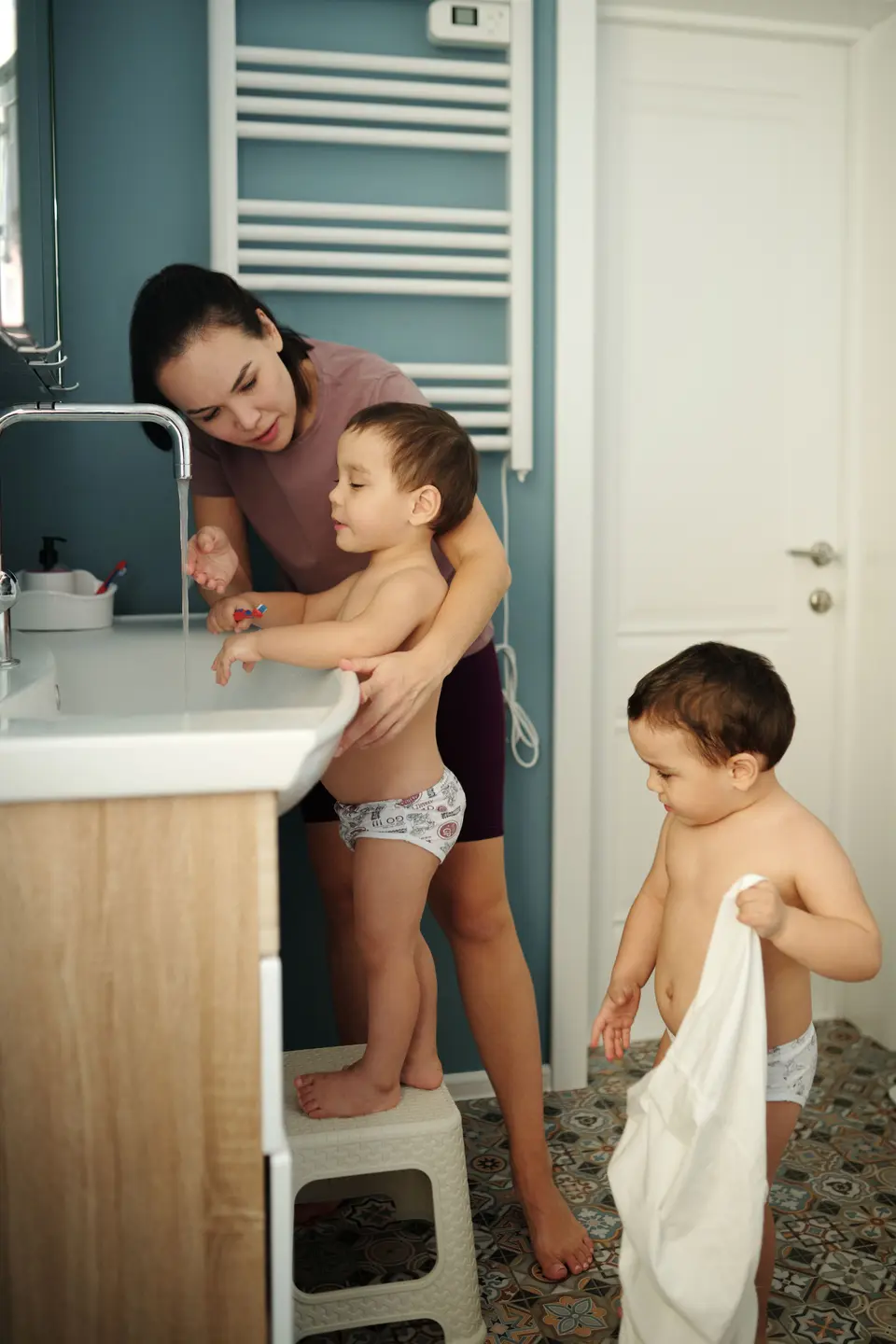
Toilet training is a natural moment to build the hygiene habits that go with it. The CDC-recommended handwashing technique, cited by HealthyChildren.org (AAP), is to wet the hands, apply soap, rub and scrub every surface of the hands well for 20 seconds to remove germs, then rinse and dry completely. Parents are encouraged to start building this habit as early as possible. Pairing it with bathroom trips gives it a built-in routine.
This same stretch of toddlerhood is also when dental hygiene habits get established. For children younger than 3, the AAP recommends brushing with only a smear or grain-of-rice-sized amount of fluoride toothpaste, twice a day, starting when the first tooth appears and continuing until age 3. It's another small, consistent habit that fits naturally alongside toilet training in this stage of independence-building.
What if my toddler has accidents or regresses?
Occasional accidents during and after toilet training are common and expected. They aren't a sign that something has gone wrong. It's worth telling them apart from true regression. Cleveland Clinic defines regression as a pattern of repeated accidents in a child who had already reached a toileting milestone, not a single isolated incident.
When that kind of pattern does show up, stress is the most common trigger. But Cleveland Clinic also notes that urinary tract infections (UTIs, infections in the urinary system) and constipation are common medical causes of regression. Both call for a pediatrician visit. If your toddler who was previously staying dry starts having repeated accidents, it's reasonable to bring it up with your pediatrician rather than assuming it will simply resolve on its own.
Frequently asked questions
What's the average age kids start potty training in the US?
According to HealthyChildren.org (AAP), toilet training typically begins between 2 and 3 years old in the United States. That's a wide window, and it's an average, not a deadline — readiness signs matter more than a specific birthday.
How do I know if my toddler is actually ready to start?
The AAP points to a cluster of signs. These include staying dry for at least 2 hours at a time during the day (or waking up dry after naps), showing physical cues before a bowel or bladder movement such as grunting, freezing, or squatting, being able to follow simple instructions and walk to and from the bathroom, disliking a wet diaper, and asking to use the potty or wear 'big-kid' underwear. Seeing several of these together is a stronger signal than any single one on its own.
Is the 3-day method or a child-led approach better?
There isn't a single right answer. Both approaches assume your toddler is already showing the readiness signs above. The 3-day method is a concentrated, structured push, while a child-led approach follows your toddler's own pace over a longer stretch. Which one fits depends on your child's temperament, your family's schedule, and how many readiness signs are already in place.
My toddler was doing great and now has frequent accidents. Is that potty training regression?
Cleveland Clinic defines regression as a pattern of repeated accidents in a child who had already reached a toileting milestone, not a single isolated accident. Stress is the most common trigger. But urinary tract infections and constipation are also common medical causes. So a pattern of regression is worth a pediatrician visit rather than something to just wait out.
My toddler isn't talking much yet — should I hold off on potty training?
Communication is part of what makes toilet training work, since your child needs to follow simple instructions and eventually tell you they need to go. ASHA notes that by 19 to 24 months, toddlers should typically understand and use at least 50 words and be combining two words together, like 'more water.' If your child isn't meeting many of the communication milestones expected for their age, ASHA recommends an assessment from a certified speech-language pathologist or audiologist. That's a good conversation to have with your pediatrician alongside your potty training plans.
Sources
- Signs that a toddler may be developmentally ready to begin toilet training include staying dry for at least 2 hours at a time during the day (or being dry after naps), showing physical signs of an impending bowel or bladder movement like grunting, freezing, or squatting, being able to follow simple instructions and walk to and from the bathroom, disliking a wet diaper, and asking to use the potty or wear "big-kid" underwear. — HealthyChildren.org (AAP)
- The average age at which toilet training begins in the United States is between 2 and 3 years old. — HealthyChildren.org (AAP)
- By 19 to 24 months, a toddler should use and understand at least 50 different words for food, toys, animals, and body parts, and should be putting two or more words together, such as "more water" or "go outside"; parents whose child does not meet many milestones in this age range are advised to seek an assessment from a certified speech-language pathologist or audiologist. — ASHA (American Speech-Language-Hearing Association)
- ASHA advises that if a child does not meet many of the communication milestones expected for their age range, parents should seek an assessment from an ASHA-certified speech-language pathologist or audiologist. — ASHA (American Speech-Language-Hearing Association)
- According to Cleveland Clinic, potty training regression is defined as a pattern of repeated accidents in a child who had already reached a toileting milestone, not a single isolated incident, and stress is the most common trigger, though urinary tract infections and constipation are also common medical causes that warrant a pediatrician visit. — Cleveland Clinic
- For children younger than 3 years old, the AAP recommends brushing with only a smear or grain-of-rice-sized amount of fluoride toothpaste, twice a day, starting when the first tooth appears and continuing until age 3. — HealthyChildren.org (AAP)
- The CDC-recommended handwashing technique taught to young children is to wet the hands, apply soap, rub and scrub every surface of the hands vigorously for 20 seconds to remove germs, then rinse and dry completely; parents are encouraged to start building this habit as early as possible. — HealthyChildren.org (AAP), citing CDC
- Most toddlers transition from two daily naps to a single nap between 18 and 24 months of age, and 2-year-olds generally need about 14 hours of total sleep per day, split between roughly 11-12 hours at night and about 2 hours during the day. — Cleveland Clinic
- Children with sensory processing (sensory integration) difficulties can find it hard to regulate their responses to everyday situations such as dressing, playing, mealtime, and social interactions. — StatPearls / NCBI Bookshelf (NIH)
Educational information, not medical advice — always consult your doctor.